
PTFE Conveyor Belt Guide Strips
Accurate Tracking and Stable Conveying Performance.
In high-temperature conveyor systems, belt misalignment is a common issue caused by uneven roller force, tension deviation, or long-distance operation. Once deviation occurs, it can lead to edge wear, delamination, and reduced service life.
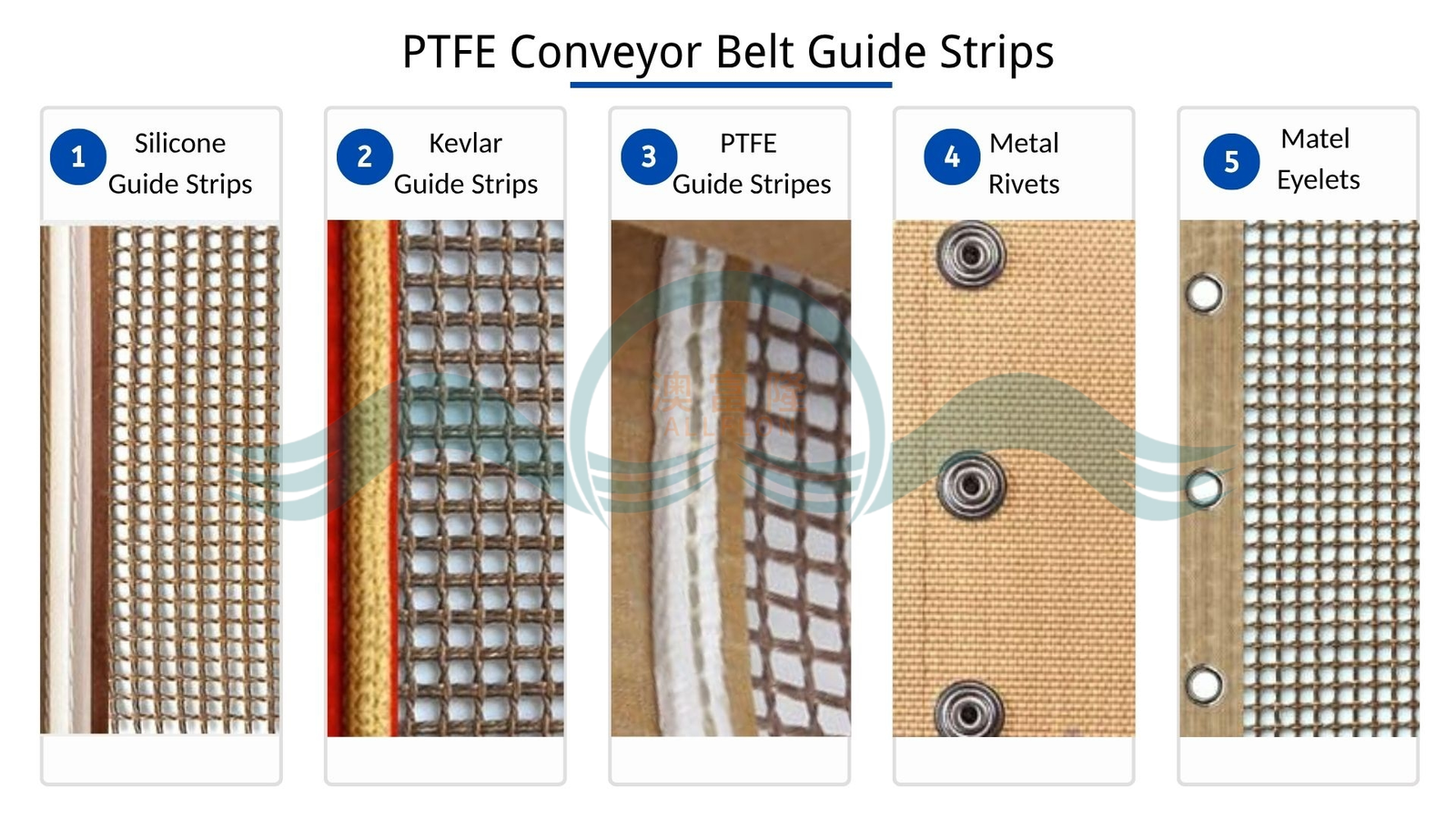
Guide strips are designed to solve this problem by providing mechanical tracking control. Installed along the belt edge, they engage with grooves on rollers or guiding systems, effectively restricting lateral movement and ensuring stable belt operation.
Main Types of Guide Strips.
Guide Strip Comparison Table
| Type | Materials | Temperature Range | Shape | Common Sizes (mm) | Advantage | Disadvantage | Typical Application |
|---|---|---|---|---|---|---|---|
| Silicone Guide Strips | Silicone | -60°C to 250°C | Semi-circular | 11 × 16 mm, 5 × 5 mm | Flexibility ,strong adhesion,food-grade,good cushioning | Moderate wear resistance,not for heavy load | Food processing,general conveying |
| Kevlar Guide Strips | Kevlar (Aramid) | Up to 200°C | Square | 3 × 3 mm, 5 × 5 mm | High strength,wear resistant Long liftspan | Less fexible,complex installation | Heavy-duty,high tension systems |
| PTFE Guide Stripes | PTFE | -70°C to 260°C | Rectangular | 5×5 mm, 5×8 mm, 8×8 mm, 5×10 mm, 8×10 mm, 10×10 mm | Low friction,non-stick,chemical resistant,high-temp | Lower strength,low elasticilty | High-temp,chemical,non-stick environments |
| Metal Rivets | Metal | Depends on systems | Point Contact | 7 mm, 10 mm | Low cost,simple,easy install | Low precision,roller wear | Basic guiding systems |
| Matel Eyelets | Metal | Depends on systems | Ring | 5 mm, 8 mm, 10 mm | Strong tracking,suitable for hgh tension | Complex,higher cost,not food-grade | Heavy-duty,forced tracking systems |