
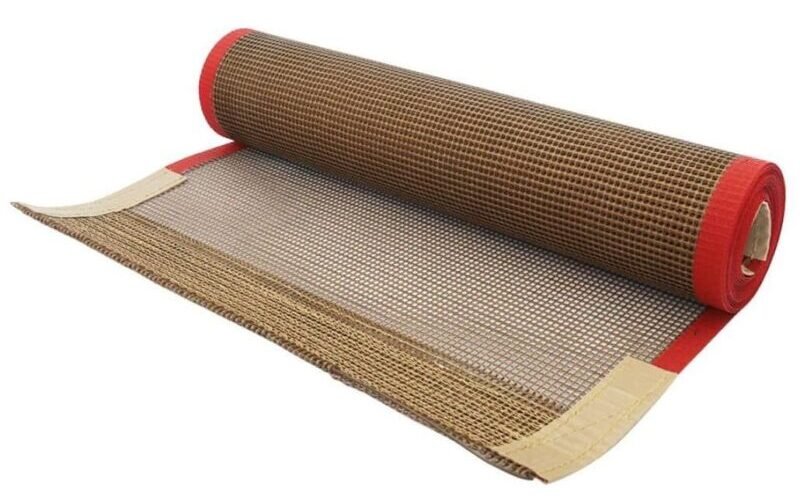
The Impact of Improper Tension (Over-Tightening vs. Excessive Slack) on PTFE Conveyor Belts
Improper tensioning of a PTFE (Teflon) conveyor belt—whether too tight or too loose—directly compromises its service life, tracking accuracy, equipment safety, and final product quality. The specific consequences are detailed below:
I. Over-Tightening (Excessive Tension)
- Irreversible Deformation and Elevated Risk of Breakage: Since the reinforcement base of PTFE belts mostly consists of fiberglass or aramid (Kevlar) fabrics, excessive tension triggers structural stretching, elongation, and flex fatigue. This results in mesh cracking, edge tearing, and coating delamination, causing the belt to lose its signature non-stick and high-temperature capabilities.
- Dramatic Increase in Mechanical Load: Drive motors, gear reducers, bearings, and pulleys are forced into prolonged overload. This accelerates thermal build-up and mechanical wear, leading to burnt motors or fractured shafts.
- Severe Tracking Off-Set: When tension is excessive, even a minor imbalance in lateral force will trigger violent belt mistracking, leading to severe edge scraping and fraying.
- Spike in Energy Consumption.
II. Excessive Slack (Insufficient Tension)
- Slippage and Unstable Velocity: Inadequate friction between the conveyor belt and the drive pulley induces slippage and rotational loss. This leads to erratic conveying speeds, inaccurate material positioning, and poor processing consistency in drying, laminating, and printing stages.
- Tracking Off-Set, Jitter, and Web Undulation: A loose belt slackens dynamically during operation, causing system vibrations, bouncing, and sagging profiles that form waves across the web, making the belt highly prone to mistracking and side friction.
- Aggravated Localized Abrasion: Poor alignment and intermittent contact between the slack sections and the idlers/pulleys cause continuous localized friction, accelerating surface coat wear.
- Degradation of Product Quality: In high-precision sectors like photovoltaics (PV), printing, curing, and heat sealing, belt slack causes substrate wrinkling, structural shifting, and uneven heat distribution.